Reface, Refresh, Reimagine: How Smart Renovators Get More Kitchen for Less Money
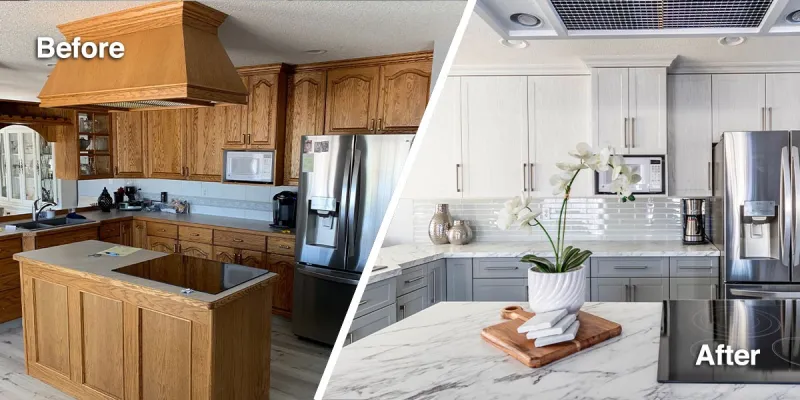
Photo: kitchen cabinet refacing before and after modern renovation, via rstatic.homedepot.ca
There is a persistent belief in renovation culture that bigger always means better — that the only way to truly transform a kitchen or commercial break room is to rip everything out and start from scratch. It is an appealing narrative, particularly when design publications showcase gleaming, gut-renovated spaces. But for a significant segment of renovators, that approach represents a costly overcorrection. Cabinet refacing, when applied to the right situation, delivers a compelling return on investment that full replacement simply cannot match.
Understanding the difference between these two paths — and knowing precisely when each one makes sense — is the foundation of any well-planned cabinetry project.
What Cabinet Refacing Actually Involves
Refacing is not a cosmetic patch job. When executed properly, it is a systematic process that replaces every visible surface of a cabinet while retaining the existing box structure. This typically includes applying new veneer or laminate to the cabinet frames, installing entirely new door and drawer fronts, replacing all hardware, and updating any exposed end panels. The result, from a visual standpoint, is indistinguishable from a brand-new installation.
The key distinction is structural: refacing assumes that the underlying cabinet boxes — the carcasses that attach to walls and support countertops — are in sound condition. If they are, those boxes become a valuable asset rather than a liability. If they are not, refacing loses its primary advantage.
The Cost Equation: Where the Savings Come From
Full cabinet replacement in the United States typically ranges from $15,000 to $40,000 or more for a mid-to-large kitchen, depending on materials, configuration complexity, and regional labor costs. That figure includes demolition, disposal of existing cabinetry, new cabinet fabrication or procurement, and installation — a process that touches every trade involved in the kitchen.
Refacing, by contrast, generally runs between 40 and 60 percent of the cost of full replacement for a comparable kitchen. The savings originate from several compounding factors:
- No demolition labor or disposal fees. Tearing out existing cabinets and hauling them away adds both time and cost to any project.
- No countertop disruption. In most refacing scenarios, countertops remain in place, eliminating a significant ancillary expense.
- Reduced installation complexity. Because the structural boxes stay put, there is no need to reconfigure plumbing, electrical, or tile work that surrounds the existing cabinetry.
- Faster project completion. A kitchen refacing project typically wraps up in two to five days. A full replacement, including all associated trades, can stretch across several weeks.
For commercial clients — restaurant operators, property managers, office facility teams — that compressed timeline carries particularly meaningful value. Every day a commercial kitchen or common area is offline represents measurable operational cost.
When Refacing Is the Clearly Superior Choice
Not every situation calls for the same solution, but several scenarios consistently favor refacing over replacement.
The bones are good, but the look is dated. If your cabinets were built with quality materials a decade or two ago and the boxes remain square, solid, and free of water damage, you are sitting on a structural foundation worth preserving. Updating the exterior finish, door style, and hardware can advance the aesthetic by twenty years without touching the infrastructure.
The budget has a firm ceiling. When a renovation must deliver maximum visual impact within defined financial constraints, refacing allows clients to redirect savings toward other high-visibility upgrades — new countertops, improved lighting, or premium appliances — that collectively elevate the entire space.
The timeline is non-negotiable. Homeowners preparing a property for sale, commercial operators facing a scheduled reopening, or landlords turning over a rental unit between tenants frequently cannot afford the extended disruption that full replacement demands. Refacing compresses the construction window dramatically.
The layout already works. Cabinet replacement makes sense when the existing configuration is fundamentally flawed — insufficient storage, poor workflow, or a layout that no longer suits the occupants. But when the current layout functions well, replacing perfectly serviceable boxes purely for aesthetic reasons is difficult to justify financially.
When Replacement Is the Right Call
Honesty is essential here. Refacing is not a universal solution, and presenting it as one would be a disservice to anyone making a serious renovation decision.
Replacement becomes the more rational choice when cabinet boxes show evidence of water damage, warping, mold, or structural compromise. Veneering over a failing carcass simply delays the inevitable and adds cost to a problem that will resurface. Similarly, clients who want to fundamentally reconfigure their kitchen — relocating the sink, expanding an island, adding a pantry tower — need new cabinetry to accommodate those structural changes. Refacing cannot reposition a box that needs to move.
There is also a long-term value consideration. For clients planning to remain in a property for twenty or more years, or those investing in a high-end renovation where premium custom cabinetry is part of the overall value proposition, full replacement with superior materials may deliver a better return over the full life of the installation.
The Hybrid Approach: A Strategy Worth Considering
Some of the most cost-effective renovation outcomes involve neither pure refacing nor wholesale replacement, but a deliberate combination of both. In this approach, structurally sound cabinets are refaced while specific sections — a damaged lower run, an outdated peninsula, or an undersized pantry area — are replaced with new custom units designed to integrate seamlessly with the refaced components.
This hybrid strategy requires careful planning and precise material matching, but it allows clients to address genuine structural deficiencies without incurring the full cost of a complete overhaul. When the new and refaced elements are specified together from the outset, the finished result is cohesive and purposeful.
Making the Decision With Confidence
The most reliable way to determine whether refacing or replacement serves a given project is a thorough, honest assessment of the existing cabinet condition — not a sales conversation driven by product margins. A qualified cabinetry professional should inspect the boxes for structural integrity, evaluate the current layout against the client's functional needs, and present a transparent cost comparison that accounts for all associated work, including countertops, hardware, and installation.
At Fast Track Cabinets, our approach to custom cabinetry is grounded in practical problem-solving rather than one-size-fits-all recommendations. Whether a project calls for a precision refacing upgrade or a complete custom installation delivered on an accelerated timeline, the objective remains the same: providing clients with a solution that performs beautifully, holds up over time, and respects the realities of their budget and schedule.
The smartest renovation is not always the most extensive one. Sometimes, the most intelligent move is recognizing the value already built into your walls — and choosing the path that honors that investment while moving the project forward efficiently.