Small Hinge, Big Difference: The Engineering and Everyday Value of Soft-Close Cabinet Mechanisms
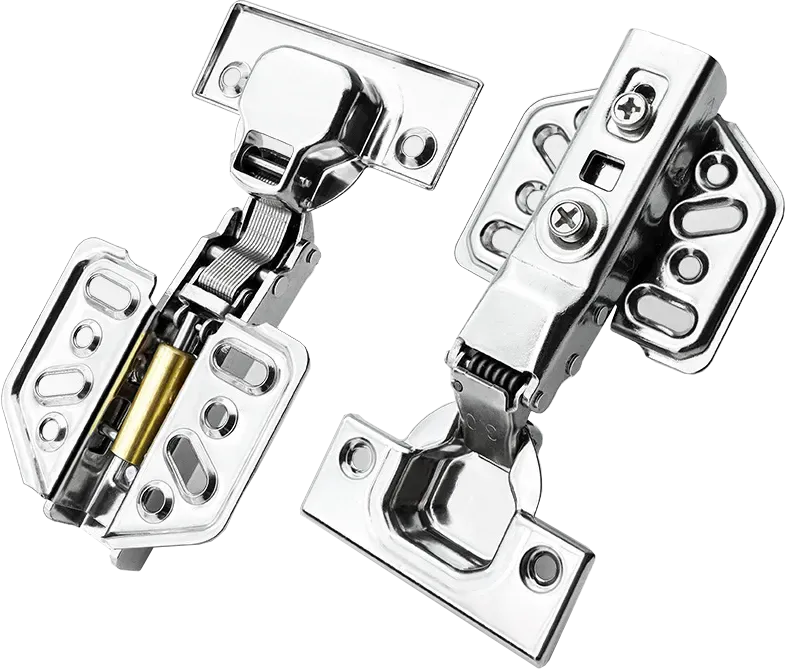
Photo: YergoX, CC0, via Wikimedia Commons
There is a moment familiar to anyone who has spent time in a well-appointed kitchen: the cabinet door glides toward the frame, slows imperceptibly in the final inch, and closes with a muted, controlled click. No slam. No rattle. No reverberating impact traveling through the cabinet box. It is a small moment, but it communicates something important—that the cabinetry was built with precision and selected with intention.
That experience is delivered almost entirely by a single, often overlooked component: the soft-close hinge.
For years, this mechanism was treated as a luxury add-on, the kind of feature reserved for high-end renovations or commercial installations where appearance and durability justified every line item. That perception has shifted considerably. Soft-close and self-closing hardware have become baseline expectations in quality cabinet construction, and the reasons extend well beyond comfort and aesthetics. Understanding the mechanics and the real-world implications of this technology helps homeowners, business owners, and contractors make more informed decisions before a single cabinet is ordered.
What Soft-Close Technology Actually Does
At its core, a soft-close hinge incorporates a hydraulic or spring-loaded dampening mechanism within the hinge body itself. When a cabinet door is closed with any degree of force—whether pushed deliberately or swung carelessly—the dampener engages in the final few degrees of travel. It absorbs the kinetic energy that would otherwise result in impact, decelerating the door and guiding it to a controlled, quiet close.
Self-closing hinges operate on a related but distinct principle. Rather than merely dampening an incoming door, they actively pull the door closed once it passes a certain threshold—typically around 15 to 20 degrees from the frame. This feature is particularly valuable in commercial environments or households with children, where doors are frequently left partially open.
Many modern hinges combine both functions: they self-close from a partially open position and soft-close through the final arc of travel. The result is a door that neither slams nor lingers ajar.
The Cumulative Cost of Cabinet Impact
To appreciate why soft-close mechanisms matter structurally, consider what happens during a standard cabinet slam. The door strikes the frame, sending a shockwave through the cabinet box. Over time, this repeated impact loosens screws at the hinge mounting points, compresses and degrades the finish at contact surfaces, and stresses the joints connecting the face frame or door to the cabinet body.
In kitchens and bathrooms—where cabinets may be opened and closed dozens of times each day—the cumulative effect of unmitigated impact is significant. A cabinet that endures thousands of slams annually will show measurable wear at its stress points within a few years. Drawer boxes loosen. Doors begin to rack slightly out of square. Finishes chip or peel at contact edges.
Soft-close mechanisms interrupt this cycle entirely. By eliminating the impact event, they preserve the structural integrity of every component that would otherwise absorb the force. This is not a marginal benefit—it is a fundamental extension of cabinet lifespan.
Noise Reduction as a Functional Benefit
In residential settings, particularly open-plan homes where kitchens flow into living areas, cabinet noise is a genuine quality-of-life consideration. The sharp crack of a cabinet door or drawer front closing repeatedly throughout the day is the kind of sensory disruption that accumulates. Households with young children, home offices, or shift workers are especially sensitive to this.
In commercial environments, the calculus is even more direct. Restaurant kitchens, hotel suites, office break rooms, and medical facility cabinetry all operate in contexts where noise reduction has tangible operational value. A quieter workspace is a more professional and productive one.
Soft-close hardware addresses this without requiring behavioral change from users. Staff and family members do not need to be reminded to close things gently. The mechanism handles it automatically, every time.
Evaluating the Investment: When Soft-Close Is Worth the Cost
For most residential and commercial cabinet projects, the incremental cost of soft-close hardware is modest relative to the total project budget. The calculation becomes straightforward when considered in terms of what it protects.
If a kitchen renovation represents a $20,000 to $50,000 investment—a common range for mid-to-upper-tier US residential projects—the additional cost of soft-close hinges across all doors and drawers typically amounts to a fraction of a percent of total spend. The protection that hardware provides to the finish, the joinery, and the overall structural integrity of the cabinetry represents a meaningful return on that marginal investment.
For commercial clients, the math shifts further in favor of soft-close hardware. Commercial cabinetry endures far greater use frequency than residential installations. A break room cabinet in an active office may see more daily interactions in a single month than a residential kitchen cabinet sees in a year. Durability under heavy use is not a preference in commercial contexts—it is a specification requirement.
There are scenarios where soft-close hardware warrants particularly close attention:
- High-traffic family kitchens, where multiple users of varying ages interact with cabinetry throughout the day
- Rental properties and multi-family units, where owners have limited control over how tenants handle fixtures
- Healthcare and hospitality installations, where hygiene, professionalism, and durability standards are elevated
- Open-plan living spaces, where kitchen noise travels freely into adjacent areas
- Premium residential renovations, where resale value and buyer perception are material considerations
What to Look for in Soft-Close Hardware
Not all soft-close hinges are engineered to the same standard. When evaluating options, several factors distinguish performance-grade hardware from budget alternatives.
Adjustability is a primary indicator of quality. Higher-grade hinges allow for three-dimensional adjustment—up and down, side to side, and in and out—which enables precise door alignment after installation. This matters not only aesthetically but functionally, as misaligned doors place uneven stress on hinge mounting points.
Dampening consistency across temperature variation is another relevant factor, particularly in environments that experience significant seasonal climate swings. Hydraulic dampeners can become sluggish in cold conditions if the fluid viscosity is poorly calibrated. Quality manufacturers engineer their dampening systems to perform consistently across the range of temperatures typical in US residential and commercial environments.
Finally, cycle rating—the number of open-close cycles a hinge is tested to withstand—provides a useful benchmark for longevity. Look for hardware rated to 100,000 cycles or more for residential use, and higher still for commercial applications.
A Detail That Defines the Whole
Cabinetry is experienced as a unified whole, but it is assembled from dozens of individual decisions. The choice of material, finish, configuration, and hardware each contributes to how the final product performs over years of daily use. Soft-close mechanisms occupy a unique position in that hierarchy: they are invisible in operation, inexpensive relative to overall project cost, and disproportionately impactful on both the longevity and the perceived quality of the finished installation.
At Fast Track Cabinets, we believe that cabinetry built to last requires hardware engineered to match. Soft-close and self-closing mechanisms are not finishing touches—they are foundational specifications that reflect a commitment to performance from the inside out. When your cabinets arrive on schedule and install without compromise, the hardware that quietly does its job every day is part of what makes that investment worthwhile.